 The Defined Contribution Institutional Investment Association (DCIIA) is a not-for-profit industry membership association focused on the improvement of industry practices and better outcomes for investors. The membership includes: investment managers, consultants, law firms, record keepers, insurance companies and plan sponsors. The DCIIA has issued a white paper outlining typical investments within a defined contribution (DC) plan. The white paper is titled: A Guide to Commonly Used DC Plan Investment Vehicles, January 2017.
The study provides some useful reference information such as : how certain investments operate and the differences between account type. It also tracks the aggregate composition of a plan’s investment distribution which shows parties how they match against the industry overall.
Finally, the study offers an extensive list of investment definitions, legal requirements and background information. One of the highlights of the study focuses on clarifying common misconceptions and myths associated with investment vehicle structure.
DEFINITIONS:
A Mutual Fund is an SEC registered investment vehicle that can pool together monies from many sources for the purpose of investing in stocks, bonds and/or other assets.
• A Collective Investment Trust (CIT) is an unregistered investment vehicle, maintained by a bank or trust company that pools together monies from eligible tax-qualified retirement plans for the purpose of investing in stocks, bonds and/or other assets.
• A Separate Account* is a portfolio of stocks, bonds, and/or other assets purchased with assets of a single investor, such as a retirement plan.
• A Fund of Funds is an investment strategy that invests in other vehicles, such as those listed above, rather than directly in stocks, bonds, or other assets. Also known as multi-manager, multi-strategy, or multi-asset class investments.
*This definition and the following discussion are not intended to encompass insurance company separate accounts, which are similar to CITs and other institutional separate accounts.
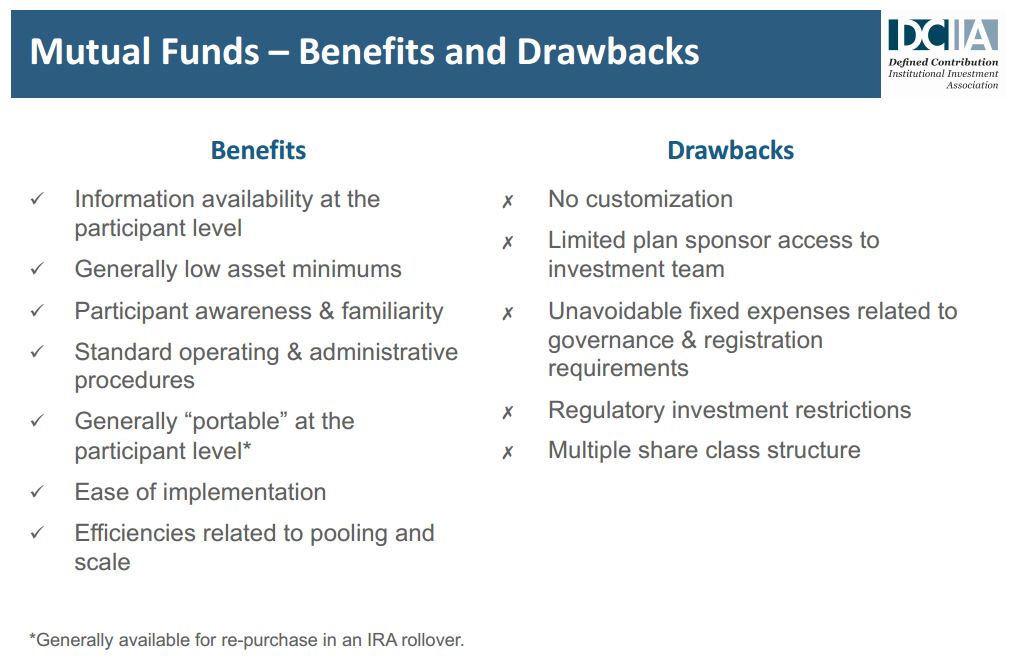
Mutual Funds (misconceptions)
- Always the most expensive option
- All are IRA rollover eligible
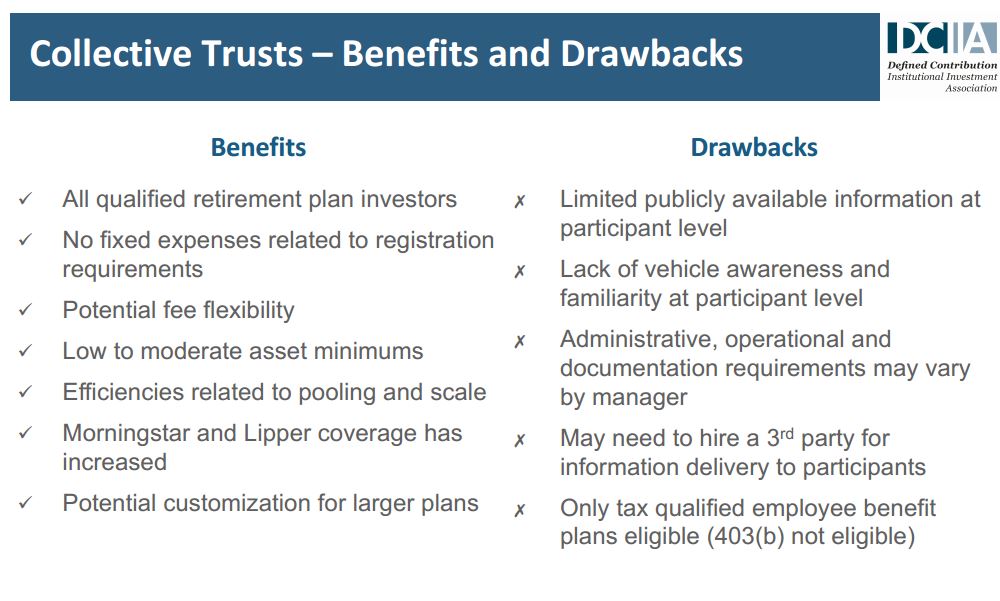
Collective Investment Trusts (CITs) (misconceptions)
- Limited available information
- Limited regulatory oversight
- New to the industry
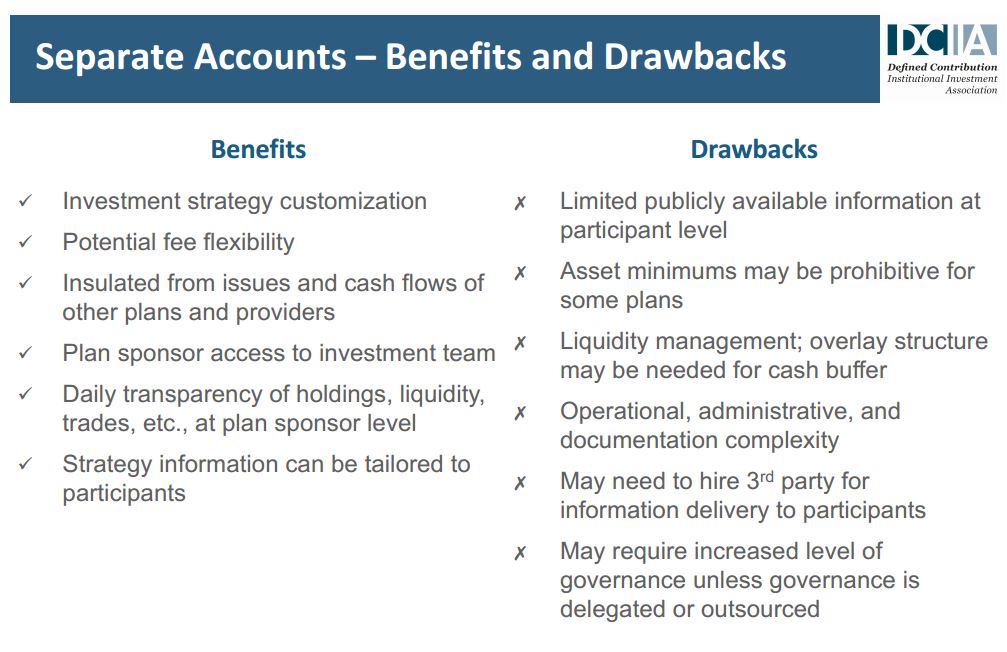
Separate Accounts (misconceptions)
- Similar to CITs
- Primarily used for defined benefit plans
- Not liquid
Fund of Funds
- Only used for mega plans
- Are always asset allocation funds