
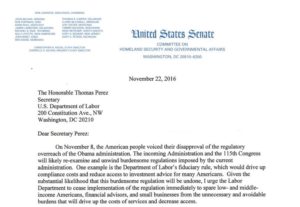
 A repeal of DOL fiduciary rule is not a certainty, but momentum is building for the case to to scuttle the rule. A few weeks ago, Senator Ron Johnson (R-Wis), chairman of the Senate Homeland Security and Governmental Affairs Committee wrote a letter to the Department of Labor Secretary Tom Perez (download) to cease implementation of what Sen. Johnson called “burdensome regulations”, including the Department of Labor’s overtime rule and fiduciary rule. The letter was endorsed by 15 other senators.
Senator Johnson further stated that “These rules are likely to be undone by the incoming administration and the 115th Congress.” The senators, led by Sen. Johnson have claimed that the DOL fiduciary rule places an unfair financial burden on small and mid-sized companies and that it discourages professionals from providing much-needed advice to individuals due to the fear of civil lawsuits and inadvertent violation of the DOL rules.
“Given the substantial likelihood that this burdensome regulation will be undone, I urge the Labor Department to cease implementation of the regulation immediately to spare small businesses and industry the unnecessary and avoidable compliance costs that they currently face”, wrote Johnson.
Johnson then referenced his February 2016 report expressing opposition to the DOL rule citing that it will cause unfair and unnecessary burdens to small and mid-sized businesses, “increase compliance costs for small-business investment advisers, increase uncertainty in the markets, and decrease the availability of investment advice for low-and middle-income Americans.”
Indeed, Johnson’s report is fairly accurate and the pending regulations have had the negative effects predicted within the report thus far, even though the Fiduciary rule has not yet been implemented. On the basis of harmful effects thus far, repeal of DOL fiduciary rule is becoming increasingly likely. Most notably, there has been an up-tick in the number of advisors exiting the space due to increased costs associated with DOL Fiduciary rule compliance, as well as aversion to liability risk.
While it is uncertain whether the Trump administration will move forward with the repeal of DOL fiduciary rule, for the moment advisors are gearing-up to be in compliance and the increased costs associated with that compliance is likely to find its way into the wallets of plan participants.


